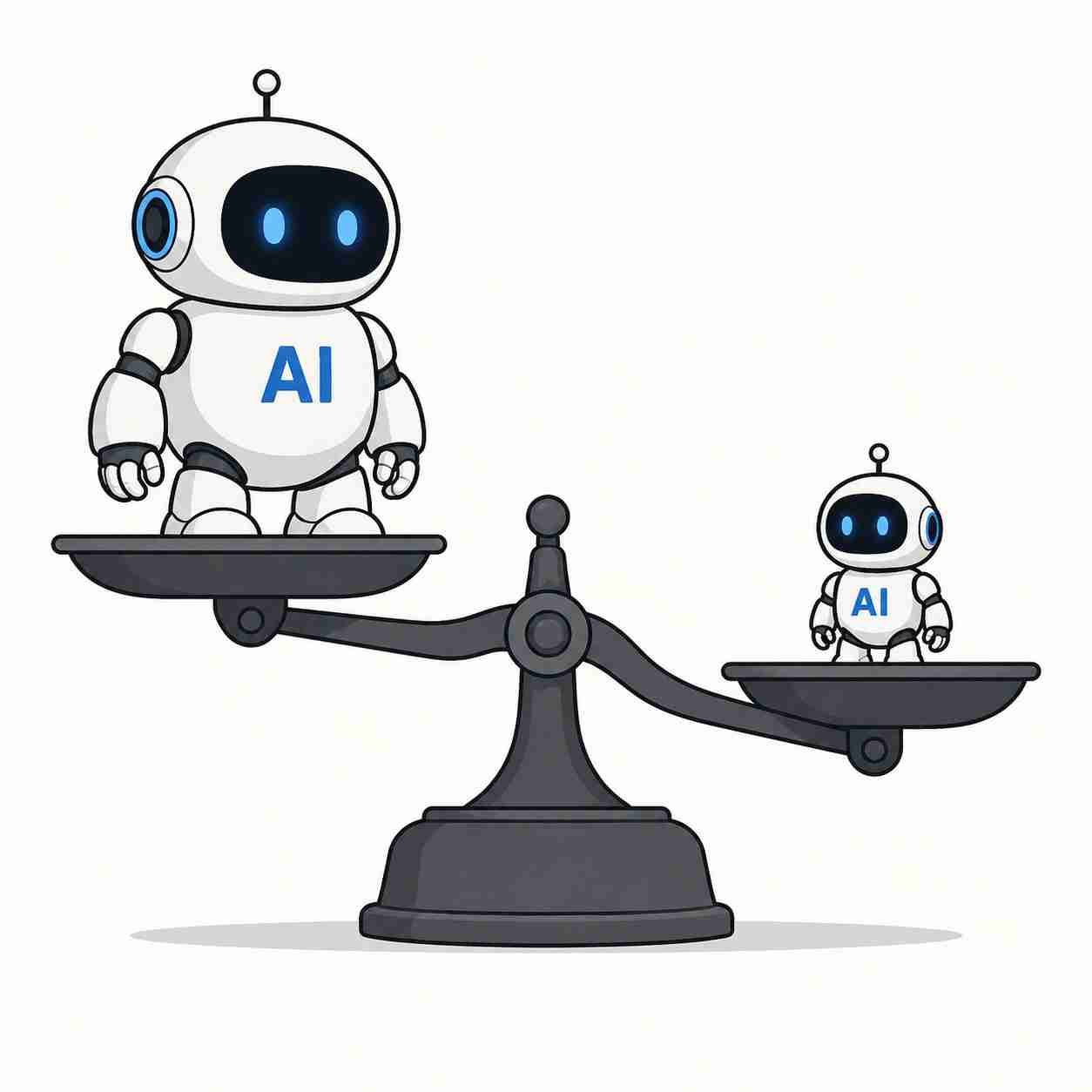

For years, progress in AI was measured in size. More parameters meant better performance, more attention, and more investment. Each new model release seemed to follow the same pattern: bigger, more capable, and more expensive. This created a simple assumption across the industry that the path forward was scale.
That assumption is starting to break. As AI moves from experimentation into real-world systems, companies are discovering that the most powerful model is not the largest one. It is the one that fits the problem, operates efficiently, and integrates cleanly into a broader system. In production environments, size alone is no longer an advantage. In many cases, it is a liability.
Why Big Models Won the First Wave
Large models dominated the early wave of AI adoption for good reasons. They offered strong general-purpose capabilities right out of the box. Teams could quickly prototype ideas, test use cases, and build demos without needing deep expertise in machine learning. The accessibility of API-based models made it easy to integrate AI into products with minimal upfront investment.
This phase was critical. It allowed companies to explore what AI could do and where it could create value. It reduced the barrier to entry and accelerated innovation across industries. For many organizations, large models were the fastest way to go from zero to something that worked.
But what worked in early experimentation does not always translate into production success.
Where Big Models Start to Break
As soon as AI systems move beyond prototypes, new constraints emerge. Cost becomes a major factor. Large models can be expensive to run at scale, especially in high-volume workflows. What looks affordable in a demo quickly becomes unsustainable when applied across thousands or millions of interactions.
Latency is another challenge. Large models often introduce delays that are unacceptable in real-time systems. Whether it is a customer support flow, a financial transaction, or a healthcare interaction, response time matters. Slower systems create friction and degrade user experience.
Control and predictability also become critical. General-purpose models are designed to handle a wide range of tasks, which makes them flexible but not always precise. In production, teams need consistent outputs, structured responses, and behavior that aligns with specific business rules. Achieving this with large, generic models can be difficult.
There are also concerns around data privacy and compliance. Sending sensitive data to external APIs is not always acceptable, particularly in regulated industries. This limits where and how large models can be used.
The result is a growing mismatch between what large models are optimized for and what real-world systems require.
What Changed: The Economics of AI Systems
The shift away from large models is not driven by a sudden drop in their capabilities. It is driven by a change in how AI is evaluated.
In early stages, success is measured by what a model can do in isolation. In production, success is measured by how a system performs as a whole. This includes cost, speed, reliability, and scalability. AI is no longer judged per prompt, but per workflow.
This changes the equation. A slightly less capable model that is faster, cheaper, and more predictable can deliver more value than a highly advanced model that is expensive and inconsistent. The focus moves from maximizing intelligence to optimizing efficiency.
This is where smaller models start to stand out.
The Rise of Small, Specialized Models
Small models are not new, but their role is evolving. Instead of trying to compete with large models on general intelligence, they are being designed for specific tasks. These models are fine-tuned on narrow domains, optimized for particular workflows, and integrated deeply into systems.
This includes distilled versions of larger models, open-source models adapted to internal data, and lightweight models deployed on edge devices. Rather than doing everything reasonably well, they do one thing extremely well.
This specialization makes them powerful in production environments. They are easier to control, easier to optimize, and easier to align with business requirements. They also allow companies to build systems that are tailored to their specific needs, rather than relying on one-size-fits-all solutions.
Why Smaller Models Win in Production
The advantages of smaller models become clear when looking at real-world systems.
Cost is one of the most immediate benefits. Smaller models require less compute, which reduces the cost per interaction. This makes them viable for high-volume use cases where large models would be too expensive.
Speed is another key factor. Smaller models typically have lower latency, enabling faster responses and smoother user experiences. In many applications, this difference is critical.
Control and predictability are also improved. Because smaller models are trained or fine-tuned for specific tasks, their outputs are more consistent. This reduces the need for complex post-processing and makes the system easier to manage.
Data governance becomes more manageable as well. Smaller models can often be deployed in controlled environments, reducing the need to send sensitive data to external services. This is particularly important for industries with strict compliance requirements.
Taken together, these advantages make smaller models a better fit for many production scenarios.
The Hybrid Model Strategy
This shift does not mean that large models are becoming obsolete. In reality, the most effective systems combine both approaches.
Large models still play an important role in handling complex reasoning, edge cases, and tasks that require broad understanding. They can act as fallback mechanisms or orchestrators within a system.
Smaller models handle the bulk of the workload. They manage repetitive, high-volume tasks where efficiency and consistency matter most. By routing tasks intelligently between models, systems can achieve both performance and efficiency.
This hybrid approach reflects a more mature understanding of AI. It is not about choosing the best model in isolation, but about designing the best system.
What This Means for Your AI Strategy
For companies investing in AI, this shift has clear implications.
First, it requires a change in mindset. Instead of asking which model is the most powerful, teams need to ask which model is the most appropriate for each task. This often leads to using multiple models within a single system.
Second, it highlights the importance of system design. Orchestration, routing, and integration become critical capabilities. The value of AI is no longer in the model alone, but in how it is embedded within a larger architecture.
Third, it creates opportunities to reduce costs and improve performance. By identifying tasks that do not require large models, companies can optimize their systems and scale more effectively.
Finally, it opens the door to greater control. Fine-tuning and deploying smaller models allows organizations to shape AI behavior in ways that align with their specific needs.
Why This Shift Is Hard for Most Teams
Despite the advantages, many teams struggle to adopt this approach.
One reason is that the industry narrative has been heavily focused on large models. Tools, vendors, and benchmarks all emphasize scale, which can make smaller models seem less attractive.
Another challenge is technical complexity. Managing multiple models, designing routing logic, and maintaining system reliability requires a different skill set than simply calling an API. Many teams are not yet equipped for this level of system design.
There is also an organizational aspect. Shifting from quick prototypes to robust systems often requires changes in process, priorities, and investment. This transition can be difficult, especially for teams under pressure to deliver fast results.
The Competitive Advantage Is in the System
The move toward smaller models is not a step backward. It is a sign that AI is maturing.
As the technology becomes more integrated into core business operations, the focus shifts from raw capability to practical value. The companies that succeed will not be the ones using the largest models. They will be the ones building the most efficient, reliable, and scalable systems around them.
In this new landscape, the model is just one component. The real advantage comes from how it is used.
That is where experienced engineering teams make the difference.
